Okay, I’m being cute with this title. (But not as cute as if I had titled this post “Cover Your Saas.” Sorry, I could not help myself.)
Why am I being cute? Because if you are a provider of Software as a Service” (meaning that you provide services over the internet but don’t actually deliver code to you customers), then the agreement you have with your customers should not involve the word “license” at all.
I was going to explain this in some detail, but alas, David Tollen over at The Tech Contracts Blog beat me to it by, oh, about a year and a half. Tollen explains it well, though, so I thank him for saving me the time and effort.
If you are a founder or executive at a SaaS company, I think it would be helpful to understand the distinction that Tollen lays out.
“If I just want to raise some seed capital from friends, I don’t have to worry about any legal issues, right?”
Ah, if only life (and the law) were that simple.
In the recent edition of goodnews, goodcounsel’s newsletter, we discussed what you need to think about when you think about taking investment capital from family and friends.
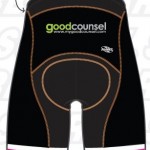
Was that the goodcounsel logo on the back of that dude’s bike shorts?
Yes it was.
I’ve previously written about why everyone should hire lawyers that ride their bikes to work. So perhaps it won’t come as a surprise that goodcounsel is now a proud sponsor of the Play It Again Sports amateur cycling team, which trains and competes around the Chicago area.
Look out for them on the road, and give them a thumbs-up and plenty of room.
In goodnews, goodcounsel’s highly occasional newsletter, I explained how early-stage companies that are set up as LLC’s can use “profits interests” instead of conventional options as a tax-advantaged way to offer employees incentive equity. There are some associated downsides and hassles, however. Read the article here.
Take a look at the section below, from a contract a client gave me to review today. What is wrong with this picture?
Found it yet?
It’s at the end, where the words say “One Hundred Seventy Five Thousand Dollars” and the numerals say “$100,000.” Notice that this is not a small-change mistake. It potentially means a difference of $75,000 in liability for one of the parties.
I would like to use Facebook more. Without a doubt, there is great utility in a social platform that everyone is on, can be used as a universal identity for logging in or commenting on other sites, etc. But because of their customer-unfriendly privacy practices, I use it rarely and with great caution. I know there are a good many others like me, and I suspect our ranks may be growing.
I know they have no choice — in their current model, if they don’t convince me to share personal data with them and then convince (or trick) me into letting them share it with advertisers, they don’t make any money. But the key phrase here is “in their current model.” Was there a different road Facebook could have taken? I think so.
After “should I form a corporation or a LLC?” this is probably the question I get asked most often. I thought I’d to try to offer a quick, simple overview, with a few links for those with an interest in the gory detail. Here goes. This is general information, not legal advice, capisce? (Duh.)
For the uninitiated, let me frame the issue: you want to raise capital for your startup. You can:
Take money from investors in return for preferred equity in the company. (Equity = ownership interests, corporate stock or LLC units. Preferred equity = the investors get all of their money back first, before profits are split according to percentages of ownership.)
Borrow money from your investors, in return for convertible notes that flip into equity down the road when you do your first equity round, per #1. The investors are almost always compensated for taking this early risk by getting a discount when the conversion takes place. E.g., if the new investors get equity at $1 per share, the note holders convert into equity at something like $.80 per share.
In my experience, convertible notes are more common. Why?
It’s quick and easy to get done. At goodcounsel, we can do this in a day or two, generally for a few thousand dollars at most.
It defers any negotiations or decisions about valuation until a later time, when actual business metrics may make the value of the company more clear.
As the Venture Hacks guys explain quite well, in most situations the math of convertible notes generally works out favorably for company/founders who can increase value quickly.
If you are dealing mostly with friends and family or other investors who are likely to work with you on the basis of trust, convertible notes will likely be acceptable. VC’s and sophisticated angel investors, on the other hand, look disfavorably upon convertible notes (e.g., Fred Wilson, Seth Levine). Their main arguments:
An equity round gives the benefit of a (presumably lower) valuation to your earliest investors, who are taking the most risk on you, and it aligns their interests with yours, because equity owners want to see the company secure a higher valuation in the next round whereas convertible debt holders, at least in theory, want the next round to be at a lower valuation, since they will convert to equity at that lower price.
Seed equity documents shouldn’t be all that expensive. (I agree – goodcounsel can get these done for less than $10,000, however, I’ve seen startups pay ridiculous amounts for equity documents.)
There is no single “right” answer here. As a purely practical matter, startups are extremely cash strapped, and the ability to do a small round for a few thousand dollars is awfully compelling. We all know that many startups raise seed money when they are still extremely immature businesses, and a good number won’t ultimately survive. It doesn’t make a lot of sense to spend more money and time on a small seed round under those circumstances.
However, I think there’s a lot to the argument that you want to be economically aligned with your angels. It motivates them to help as much as they can, plus, these are usually people you know well. You want them to fully share in your success.
My take is this: use a convertible note when you need to raise a small amount of money, inexpensively, to buy you a few months to prove the business concept and get quickly to the point where raising a larger round becomes feasible. When you raise a larger round a few months later, your convertible note investors will still get a reasonable valuation, their discount will fairly compensate them for a few months of greater risk, and you won’t mind spending a little more time and money to get it done.
As with all questions like this, I always tell people that it’s an important issue, but not one that should distract you for very long. You’ve got a business to create, and time is your most precious asset. Neither decision is wrong, so make the decision and move on.
——
I did not cover, above, the ways that convertible note rounds can be made more “equity-like.” The how’s and why’s of price caps are explained well by Brad Feld, among others. Price caps are okay, but then — as with a recent client experience — a smart founder will want a corresponding “floor.” (The price cap protects the investor on the upside, by placing a maximum valuation on the later conversion, and the floor protects the company/founder, by placing a minimum valuation on the later conversion.) Once you start going down this road, my view is that you start losing the advantages of the convertible note, and you might as well just go with a priced equity round.
UPDATE 9-14-12: For those interested in understanding these issues in horrific detail, I see that Mark Suster has a detailed post out on the subject (hat tip: Technori). Some interesting and quite valid perspectives there, and in the comments too. My take is that — outside, perhaps, very sophisticated VC’s negotiating with very sophisticated founders over very significant rounds — it’s just not worth the brain damage getting into it at this level. Maybe if you’re a VC who negotiates deals for a living…
I know it’s not front-page news that big law firms charge big fees. I should know; I worked at a couple of them. Still, I’ve been out of that world for a long time now, and one forgets.
So, without naming any names, here’s a story: A startup client of mine recently secured a significant equity investment from a major local private equity investor – a commitment in excess of $25 million. As is often the case, the investor dictated the lawyers that the company had to use. (Hint: it wasn’t me.)
The deal just closed, and I caught up with my client to get the lowdown. The legal fees on the deal were – wait for it – over $175,000. Read the rest of this entry »
Playground fun or death trap? Photo credit: Gabriel Pollard
I have young children, so I’ve been frequenting playgrounds over the last 8 years or so. I’ve noticed, during this time, that there’s an incredible degree of sameness to them. Something has homogenized our playgrounds. They are almost uniformly boring.
One example: I noticed that a staple of the playgrounds of my youth, the see-saw, is gone – gone, or replaced with a bastardized version with springs rather than a fulcrum, so that at rest, instead of one side being up and the other side down, it just sits there horizontally. The problem, of course, is that even when kids are using it, the springs prevent it from going up or down much on either side. What is the point of a seesaw that doesn’t go up and down? Lord have mercy. No wonder my kids have no interest in these.
I thought about it for about a half-second, and figured that personal injury lawyers must have something to do with this situation.
And indeed, it seems to be the case that after a spate of personal injury litigation in the 1970’s, municipalities started tearing up playgrounds, taking out equipment such as high jungle-gyms and fulcrum seesaws, and replacing them – if at all – with “safer” equipment. Safer, as in less challenging and less fun. (As an aside, I wonder if the problem in the 1970’s, when cities were going bankrupt, wasn’t so much with playground equipment per se, but rather, with poorly maintained equipment.)
I am sure that you can find some terrible stories of children getting hurt on playground equipment, but it’s hard for me to believe that they are a statistically significant source of childhood injuries. Checking the CDC website, one learns that in the decade 1990 to 2000 there were 147 playground deaths of children 14 and under. Each of those was a tragedy for a family. But looking at this scientifically, this amounts to just under 15 deaths per year. Some of these deaths, according to statistics, were due to inadequate supervision or other causes, not any inherent danger of the equipment. Now, look at the overall mortality rates for this age group. In just one year, 2008, 4,643 children age 14 years and under died from “unintentional injury.” Doing the division, this means that playground accidents accounted for three-tenths of one percent of the accidental fatalities. The leading causes were, in order: motor vehicle crashes, suffocation, drowning, and fires/burns. (So, if you really want to protect your child, live in a densely settled, walkable neighborhood that doesn’t require car trips for everything. Your family will be healthier in every way.)
Fortunately, it appears that the pendulum may be swinging back. (Swinging pendulums? Those are dangerous!) Experts in child play (what a great job that must be) have begun to appreciate the extent to which kids need challenges and, yes, just a little bit of danger in order overcome fears and master the real world — a world in which springs cannot be attached to everything to smooth out the highs and lows.
There’s a lesson to be learned that goes beyond playgrounds. People in general and lawyers in particular seem to think that all risk can be eliminated. Of course, it can’t be. A certain amount of risk is inherent in every human activity. By going overboard to stamp out risk – to prevent whatever small part of the 15 annual playground deaths that can be attributed to “dangerous” equipment – we have spent millions tearing up nice old playgrounds, and replacing them with bland, boring ones that don’t serve the intended developmental purposes. So, in which scenario lies the greater cost?
In business deals, the lawyer you want at your side is the one who tries to minimize risk but who also realizes that risks are unavoidable and, that by trying to avoid them completely, you run the larger risk of killing the deal entirely – losing out on potentially greater benefits.
Next time you are thinking about hiring a lawyer, ask where he or she stands on the issue of seesaws.